Supplement safety: interactions, dosing, and the "natural" myth
Supplements aren't automatically safe. A plain-English guide to drug interactions, dosing limits, surgery precautions, and why "natural" doesn't mean risk-free.
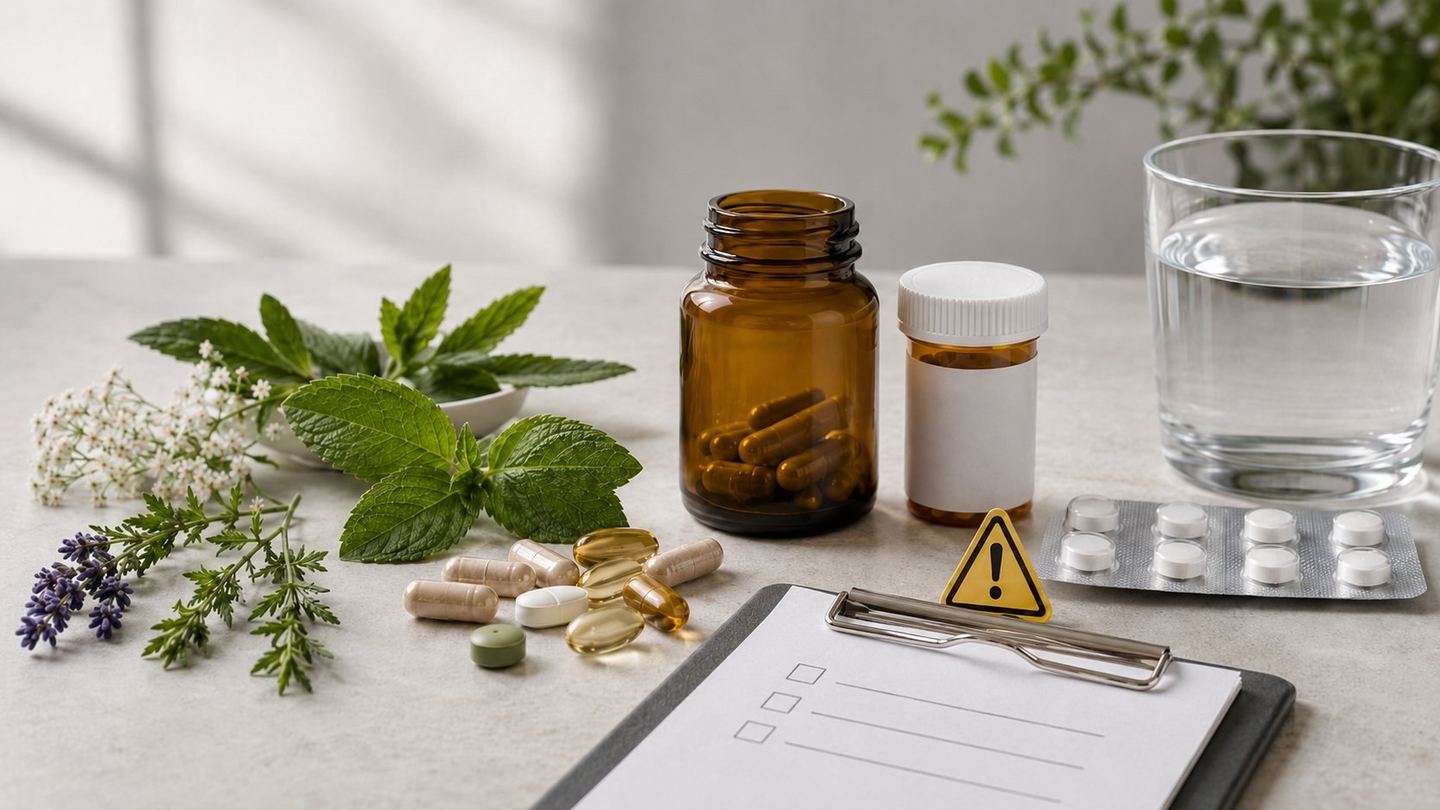
It's easy to assume that anything sold without a prescription must be gentle, and that "natural" is just another word for "safe." Neither assumption holds up. Dietary supplements can contain ingredients with real effects in the body — which is exactly why they can also carry real risks, interact with medications, and cause harm at the wrong dose. This article is general safety literacy, not medical advice: it covers how to think about supplement safety and what to raise with a qualified professional.
Key points
- "Natural" doesn't mean safe — some botanical products can harm the liver or other organs.
- Supplements can change how a medication works, making it weaker or stronger than intended.
- Dose matters: more isn't safer, and several nutrients are harmful in excess.
- Tell every provider what you take — and check before surgery, pregnancy, or a new medication.
"Natural" doesn't mean safe
A product being plant-derived, "all-natural," or simply available on a shelf tells you nothing about whether it's safe for a particular person at a particular dose. A supplement's safety depends on its chemical makeup, how it acts in the body, how it's prepared, and how much you take. Some all-natural botanical products can do real harm — comfrey and kava, for example, have been linked to liver damage. "Natural" is a marketing word, not a safety rating.
It's also worth knowing how supplements are regulated, because it shapes the risk. Unlike prescription and over-the-counter medicines, supplements don't have to be reviewed by the FDA for effectiveness before they're sold. Manufacturers — not a regulator — are responsible for making sure a product is safe and labeled truthfully before it reaches the market. That's a meaningfully different safety net from the one behind approved medications.
How supplements interact with medications
One of the most underappreciated risks is interaction with prescription or over-the-counter drugs. A supplement can change how a medication is absorbed, broken down, or cleared from the body — and the result can be that you get too much or too little of the medicine you actually need. Most interactions fall into one of a few patterns.
| Interaction pattern | What can happen | Documented example |
|---|---|---|
| Reduced drug effectiveness | The supplement speeds up how the body clears a medication, lowering its level | St. John's wort can make drugs for HIV, heart conditions, depression, transplant, and birth control less effective |
| Additive effect | The supplement and drug push in the same direction, amplifying it | Warfarin, aspirin, ginkgo, and vitamin E can each thin the blood; combining them may raise the risk of internal bleeding or stroke |
| Altered absorption | The supplement binds with or competes against a drug, changing how much is taken up | Certain minerals and fibers can interfere with how some medications are absorbed |
These examples are illustrative, not a complete list. The practical takeaway isn't to memorize specific pairs — it's to assume interactions are possible and to check. A pharmacist is often the most accessible expert for exactly this question, and can review a full list of what you take against your prescriptions.
Before a procedure or surgery
Surgery is one situation where supplement safety becomes especially important. Some supplements affect bleeding, heart rate, or blood pressure, and can interact with anesthesia or other drugs used before, during, and after a procedure. Because of this, a surgical or anesthesia team may ask you to stop certain supplements roughly two to three weeks ahead of time.
The step that matters is simple: tell the team everything you take — including vitamins, minerals, and herbal products — well before the date, and then follow their specific instructions rather than guessing on your own.
Dose matters — more isn't safer
"If a little is good, more must be better" is a particularly risky instinct with supplements. Many nutrients have an upper limit beyond which they stop helping and start causing harm. Fat-soluble vitamins (A, D, E, and K) can build up in the body rather than being flushed out, and some minerals are toxic in excess. As a measure of how routine this risk is: among young children, accidental iron overdose is a surprisingly common form of poisoning — one reason anything containing iron should be stored well out of their reach.
Stacking also adds up quietly. A multivitamin, plus a few single-nutrient products, plus a fortified food or drink can push total intake past safe limits without anyone noticing — because no single product looks like "too much." Checking the actual amount per serving against established upper limits (the NIH Office of Dietary Supplements publishes these for individual nutrients) is part of using any supplement responsibly.
A simple safety routine
A few habits cover most of the real-world risk.
- Keep a current list of every supplement and medication you take, with the dose and the reason, and share it with each of your providers. The NIH Office of Dietary Supplements offers a free printable record for this purpose.
- Ask before you start. Run any new supplement past a doctor, pharmacist, or registered dietitian first — especially if you take prescription medication or have a health condition.
- Flag the high-stakes moments. Pregnancy, breastfeeding, an upcoming surgery, or a new prescription are all good reasons to re-check what you're taking.
- Watch the total, not just the product. Add up what you're getting from supplements and fortified foods together, then compare against upper limits.
- Treat "miracle" and "all-natural" claims as marketing, not as safety information.
The bottom line
Supplements are regulated differently from medicines: they don't have to be proven effective before sale, and "natural" is not a safety standard. None of that makes them dangerous by default — it makes them something to use deliberately rather than casually. The single most protective habit is also the simplest: keep an accurate list of what you take, and talk it through with a qualified professional before you add, stack, or stop anything.
References (4)
- Dietary Supplements: What You Need to Know — Consumer Fact Sheet — NIH Office of Dietary Supplements
- Mixing Medications and Dietary Supplements Can Endanger Your Health — U.S. Food and Drug Administration
- Using Dietary Supplements Wisely — NIH National Center for Complementary and Integrative Health
- Likhitsup, Chen & Fontana — Estimated Exposure to 6 Potentially Hepatotoxic Botanicals in US Adults (JAMA Network Open, 2024) — JAMA Network Open
Wellthrive
Get early access to Wellthrive
Join the waitlist for Wellthrive — a nutrition and wellness app for clearer, more practical health decisions.
Get early access to Wellthrive