Why good health apps collect less
A look at data minimization — why collecting and keeping less personal information can protect your privacy, and what to look for in a health app.
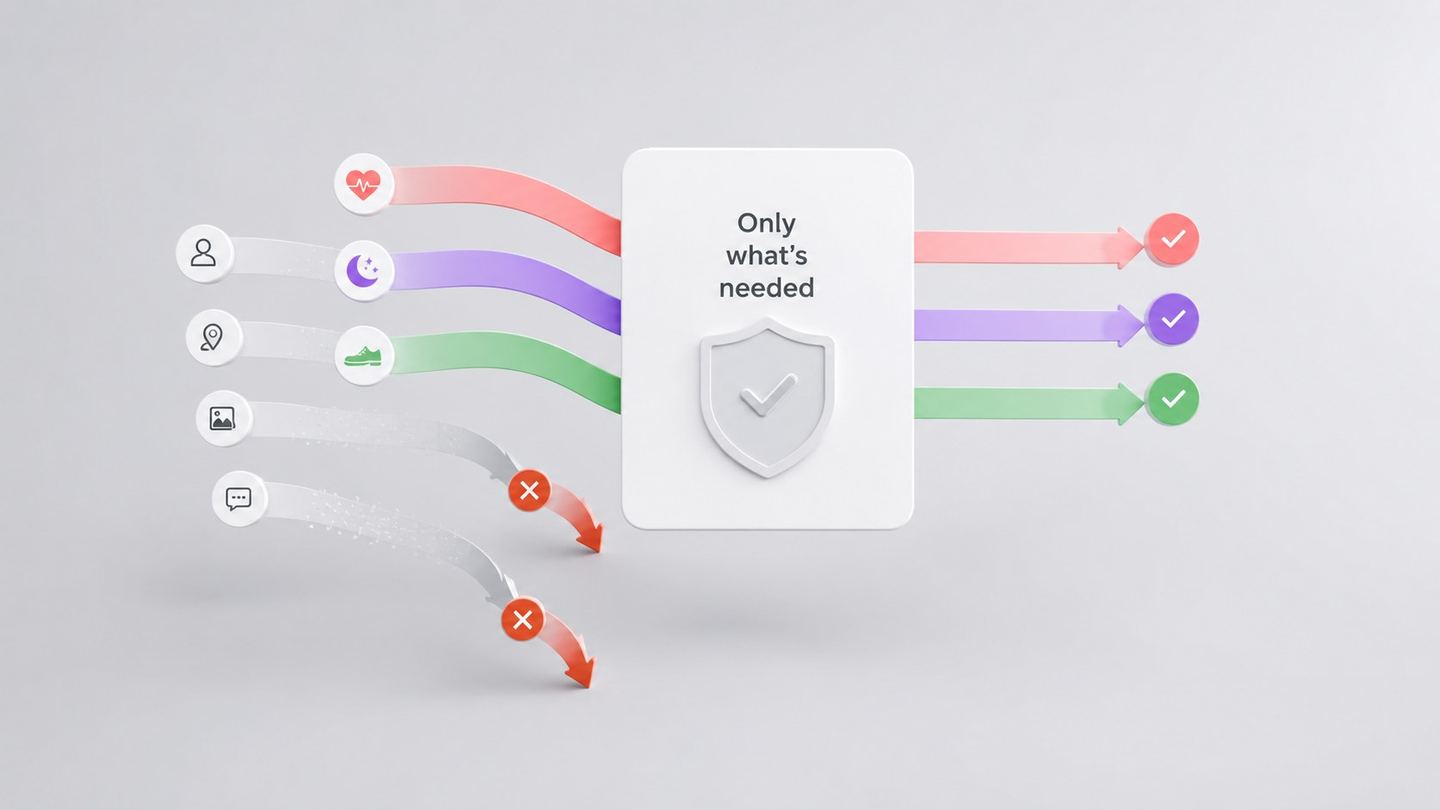
The instinct with software is usually more — more features, more integrations, more data captured "just in case." With health information, that instinct runs the other way. The most privacy-protective apps are often the ones that deliberately collect and keep less. The idea has a name: data minimization.
Key takeaways
- Data minimization means collecting only the information a product actually needs, and keeping it only as long as there is a reason to.
- Data you never collect can't be breached, sold, or re-identified later.
- Stripping obvious identifiers ("de-identification") reduces risk but never fully rules out re-identification.
- A policy that names a narrow set of collected data often protects you more than a sprawling one full of permissions.
What data minimization actually means
Data minimization is a principle, not a single feature. The U.S. Federal Trade Commission, in its guidance for health app developers, puts the starting question plainly: do you need to collect and retain the information at all? If data isn't integral to the product, the safest choice is to not gather it — and to delete what you do gather once there's no longer a legitimate reason to keep it. Everything an app holds is something it then has to secure, and something that can be exposed if things go wrong.
That reframes privacy from a downstream problem ("how do we protect all this data?") to an upstream one ("how much of this do we need in the first place?").
Why less is safer
The logic is almost boringly simple, and that's the point:
| If an app… | Then… |
|---|---|
| never collects a data point | it can't be leaked, sold, subpoenaed, or re-identified — there's nothing there |
| collects it but deletes it on a schedule | the window in which it's exposed is bounded, not indefinite |
| collects and keeps everything indefinitely | every future breach, acquisition, or policy change puts that data back in play |
The data you never collect is the data that can never leak.
Retention is the quiet half of this. Two apps can collect the same thing, but the one that discards it after it has served its purpose carries far less risk over time than the one that keeps it forever "in case it's useful later."
The "de-identified" caveat
A common reassurance is that data has been "de-identified" — names and obvious identifiers stripped out. That helps, but stripping identifiers doesn't make a dataset truly anonymous. The FTC notes that re-identification is always a risk, especially as datasets get combined and techniques improve. HHS's HIPAA de-identification standard exists precisely because doing it well is hard: it requires either removing a specific list of identifiers or having an expert judge that the re-identification risk is "very small."
So the label marks a spectrum of effort, not a magic word. Detailed location traces, rare combinations of attributes, or data joined against other sources can sometimes be walked back to a person.
What to look for as a reader
You don't need to audit an app's database to get a feel for how it handles collection. A few signals in the privacy policy tell you a lot:
- Scope of collection — Does it name a short list of what it gathers, or claim broad rights to "any information related to your use"?
- Retention — Does it say how long data is kept, or is deletion vague or absent?
- Purpose limits — Is data tied to running the product, or reserved for open-ended "business purposes"?
- Third parties — Does it commit that partners won't re-identify or resell data?
An app that can describe what it collects in a sentence or two, and says when that data goes away, is usually one that thought about minimization before writing the policy.
Collecting less isn't a limitation dressed up as a virtue — it's a design decision, made before the first byte is stored, that quietly shrinks how much can ever go wrong.
References (3)
- FTC — Mobile Health App Developers: FTC Best Practices — U.S. Federal Trade Commission
- FTC — Consumer Privacy (Start with Security) — U.S. Federal Trade Commission
- HHS — Methods for De-identification of PHI — U.S. Department of Health and Human Services
Wellthrive
Get early access to Wellthrive
Join the waitlist for Wellthrive — a nutrition and wellness app for clearer, more practical health decisions.
Get early access to Wellthrive