The role of consent in modern health apps
Consent in health apps is more than a checkbox. A clear-eyed look at what real consent should look like — and what to watch for.

Health data is some of the most personal information a person can generate. Sleep, food, weight, cycle, training, heart rate, glucose — taken together, these can describe a life in extraordinary detail. The question of who gets to see that data, under what terms, and for what purpose, is what consent in modern health apps is really about.
In most app stores, consent is presented as a checkbox at signup. That's not consent. That's an agreement to use the product. Real consent is something more layered, ongoing, and revocable.
Key points
- Real consent is more than a signup checkbox — it's layered, ongoing, and revocable.
- Meaningful consent is specific, granular, read-only by default, and easy to withdraw.
- Health data is sensitive in kind: a cycle log, glucose record, or sleep log can reveal far more than most categories.
- Clear, consistent answers across the marketing site, in-app flow, and legal documents are the signal to look for.
What meaningful consent looks like
A few principles separate genuine consent from the legal-cover version.
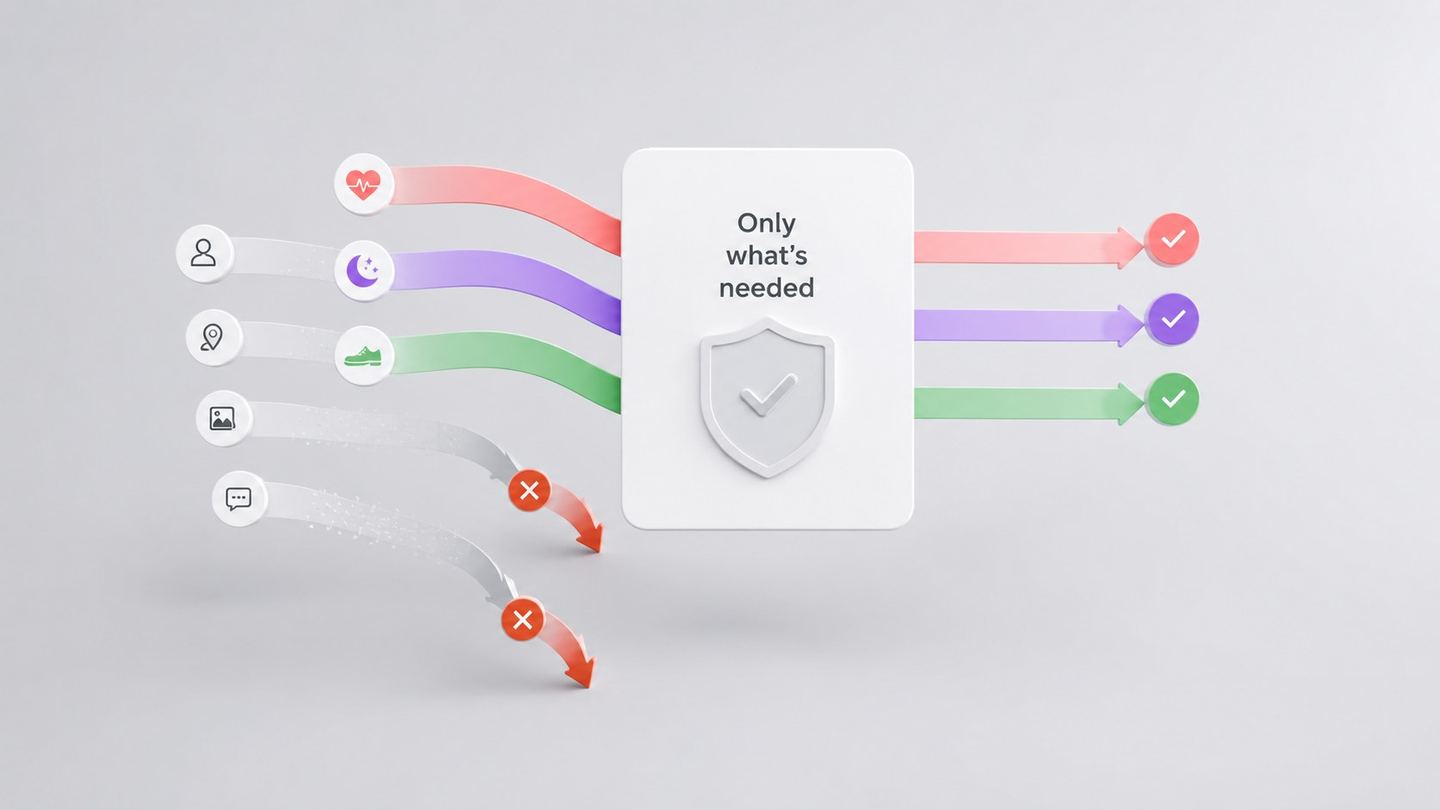
Specificity. People should be told what data is being collected, why, and how it will be used — in language that a non-lawyer can understand. "We may use your data to improve our services" is not specificity. "We use your meal logs to generate your weekly nutrition summary on the dashboard" is.
Granularity. Different data types deserve separate decisions. Allowing a nutrition app to read your food logs is a different decision from allowing it to read your menstrual cycle, your sleep records, or your continuous glucose data. A single all-or-nothing toggle isn't real granularity.
Read-only by default. If an app needs to write data back to a connected source — for example, modifying records in a separate health platform — that should be a separate, explicit decision, disclosed in plain language. Read-only access is a meaningfully different commitment from read-and-write.
Revocability. Consent that can't be withdrawn easily isn't really consent. Users should be able to disconnect data sources, pause sharing, and delete their data without contacting support, navigating five screens, or sending an email and waiting.
What the dark patterns look like
A few patterns are worth recognizing in the wild.
| Dark pattern | What it looks like | Why it matters |
|---|---|---|
| Pre-checked boxes | Opt you into broader data use unless you uncheck them | Consent you didn't actively give isn't really consent |
| Bundled consents | Hide controversial uses inside a long agreement | Separates the decision from the moment you'd actually weigh it |
| Friction around opting out | Easy to enable, hard to turn off | The asymmetry nudges you toward more sharing |
| Vague secondary uses | "To improve our services and for analytics," unexplained | You can't evaluate a use that isn't actually described |
| No clear path to deletion | Deletion that takes months or leaves "anonymized" copies | Data you can't remove is data you don't control |
When you see these, the system is designed to extract consent rather than earn it.
Why this matters more for health than for most categories
Most data leaks are inconvenient. Health data leaks can be different in kind. A cycle log can reveal a pregnancy. A glucose record can hint at a diagnosis. A sleep log can correlate with mood. A weight history can be misused in ways most people would never agree to if asked directly.
That's why a higher bar is appropriate for this category — and why opaque or extractive consent practices in health apps deserve more skepticism than the same patterns in, say, a streaming service.
What to look for in an app
Before connecting any data source or logging anything personal, a few questions are worth asking:
- Does this app explain which data it requests, and why, in plain English?
- Are data permissions granular, or one big switch?
- Are health connections read-only by default? If write access exists, is it disclosed up front for each specific feature?
- Is data sold, shared with advertisers, or used for ad targeting? (A clear "no" should be findable, not buried.)
- Can I delete my account and all associated data myself, easily, and within a clearly stated time window?
- Is there a clear, unambiguous statement that the app does not provide medical advice?
If those answers are clear, present, and consistent across the marketing site, the in-app flow, and the legal documents, that's a meaningful signal. If they're missing, vague, or contradictory, that's also a signal.
The bottom line
Consent in health apps isn't a legal formality. It's the structure that determines whether your relationship with a product is fair. The apps worth trusting tend to be the ones that treat consent as ongoing, specific, and revocable — and that make those properties easy to verify.
References (3)
- FTC — Collecting, Using, or Sharing Consumer Health Information? (business guidance) — U.S. Federal Trade Commission
- FTC — Health Breach Notification Rule (16 CFR Part 318) — U.S. Federal Trade Commission / eCFR
- FTC Act Section 5 (15 U.S.C. § 45) — Cornell Legal Information Institute
Wellthrive
Get early access to Wellthrive
Join the waitlist for Wellthrive — a nutrition and wellness app for clearer, more practical health decisions.
Get early access to Wellthrive