mg/dL or mmol/L? Making sense of lab report units
What mg/dL, mmol/L, ng/mL and nmol/L mean, why lab reports use different units, and how to convert glucose, cholesterol and vitamin D results.
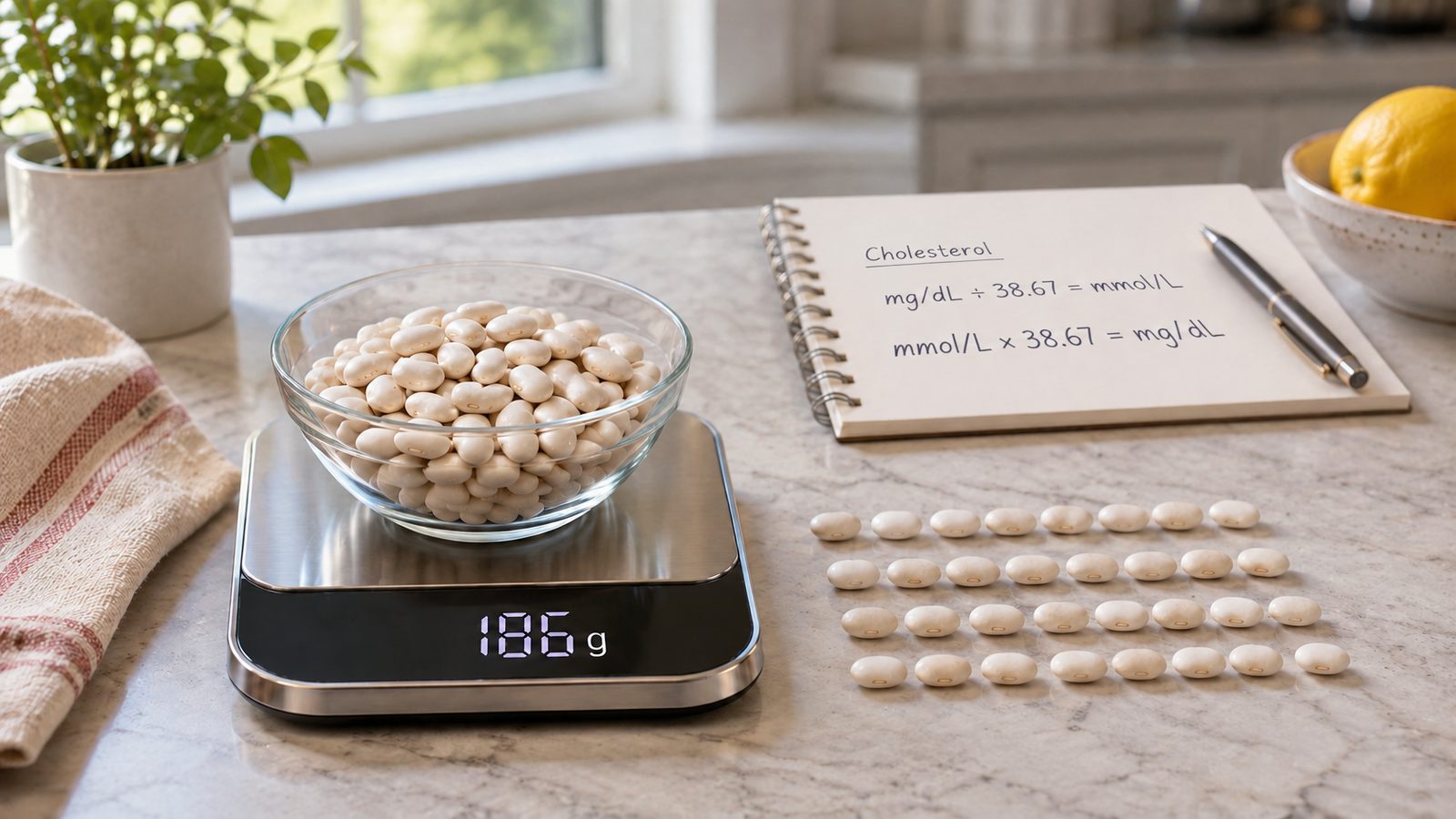
A bowl of beans can be described by its weight on a scale or by the number of beans in it. Lab reports describe what is in your blood in the same two ways.
Units such as mg/dL give a substance's weight, and units such as mmol/L give a count of its molecules. So two reports can show the same cholesterol result as numbers that look unrelated, one in the hundreds and one in single digits. Neither is a mistake, and one number per test converts between them.
What the letters mean
| Unit | Read it as | What it tells you |
|---|---|---|
| mg/dL | milligrams per deciliter | How much the substance weighs, in one-tenth of a liter |
| mmol/L | millimoles per liter | How many molecules there are, counted in moles, in a liter |
| ng/mL | nanograms per milliliter | Weight again, in much smaller units |
| nmol/L | nanomoles per liter | A molecule count again, in much smaller units |
Grams measure weight. Moles measure a count: a mole is a fixed number of molecules, the way a dozen is a fixed number of eggs, only vastly larger. These count units are often called SI units, after the International System of Units.
Why reports differ
Both kinds of units are in use. Count units such as mmol/L follow the international system described above, while weight units are still common in the United States. MedlinePlus, for instance, notes that "Cholesterol is usually measured in milligrams (mg) of cholesterol per deciliter (dL) of blood."
So the unit on a report depends partly on where the test was run. Comparing results across countries, labs or apps is where mix-ups start.
Common tests in both units
The examples below were picked only to show the arithmetic; they aren't targets.
| Test | Weight unit | Count unit | Weight to count | Example |
|---|---|---|---|---|
| Glucose (blood sugar) | mg/dL | mmol/L | Divide by 18.02 | 90 mg/dL is about 5.0 mmol/L |
| Cholesterol | mg/dL | mmol/L | Divide by 38.67 | 186 mg/dL is about 4.8 mmol/L |
| Vitamin D (the usual blood test) | ng/mL | nmol/L | Multiply by 2.5 | 24 ng/mL is 60 nmol/L |
To go the other way, reverse the step: multiply where the table says divide, and divide where it says multiply.
Before you compare two reports
- ✓ Same unit? A 5.0 on one report and a 190 on another can't be compared until both are in the same unit.
- ✓ Right number for the test? 38.67 belongs to cholesterol. Glucose uses 18.02, and other tests have numbers of their own.
- ✓ Range in the same unit? A reference range (the comparison range printed beside a result) in mg/dL only applies to results in mg/dL.
- ✓ Rounded only at the end? Do the whole calculation first and round only the answer. Rounding partway through adds error.
The unit is part of the result, not decoration. Read the letters with the same care as the digits, and two reports that seemed to disagree usually turn out to be describing the same thing in different measures.
References (5)
- mole — International Bureau of Weights and Measures (BIPM)
- Cholesterol Levels — MedlinePlus, U.S. National Library of Medicine
- CLR (Cholesterol) Ligand Summary Page — RCSB Protein Data Bank
- Glucose — NIST Chemistry WebBook (NIST Standard Reference Database 69)
- Vitamin D — Health Professional Fact Sheet — NIH Office of Dietary Supplements
Wellthrive
Get early access to Wellthrive
Join the waitlist for Wellthrive — a nutrition and wellness app for clearer, more practical health decisions.
Get early access to Wellthrive