How to read a Nutrition Facts label
A general guide to reading the U.S. Nutrition Facts label — serving size, calories, % Daily Value (the 5/20 rule), added sugars, sodium, and trans fat.
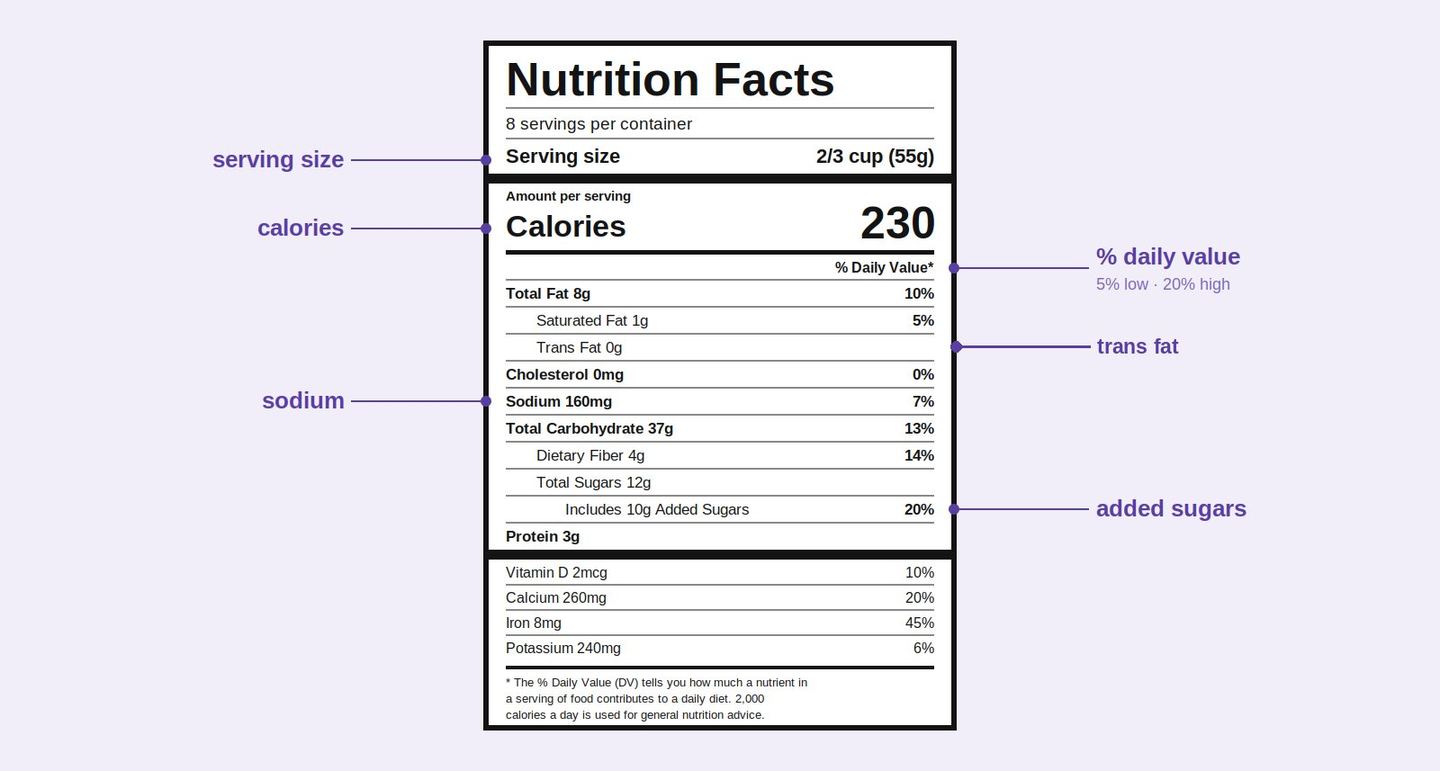
The Nutrition Facts label packs a lot into a small box, and a few orientation points make it much easier to read. This article is a general guide to what each part of the U.S. label means. It doesn't tell anyone what to eat or recommend any product — it's about reading the label itself.
Key points
- Every number on the label is per serving, so start with the serving size.
- Calories and % Daily Value give a quick sense of a food's contribution.
- As a rule of thumb on % Daily Value, 5% or less is low and 20% or more is high.
- Added Sugars and Sodium are two lines many people look for specifically.
- For trans fat, a "0g" label and the ingredient list can tell slightly different stories.
Start with the serving size
At the top, the label shows the serving size and how many servings are in the package. Everything below — calories, grams, and percentages — refers to one serving. If a package holds three servings and you eat the whole thing, the numbers triple. Checking this first keeps the rest in context.
Calories
Calories tell you how much energy one serving provides. The figure is neutral information — it doesn't make a food "good" or "bad," and how it fits depends on the rest of someone's day.
% Daily Value, and the 5/20 rule of thumb
The "% Daily Value" column shows how much a nutrient in one serving contributes to a general 2,000-calorie reference diet. A widely used shortcut: about 5% DV or less is low in that nutrient, and 20% DV or more is high. That makes it easy to scan whether a serving is a little or a lot of something, without doing any math.
Added Sugars
Under "Total Sugars," the label breaks out "Added Sugars" — sugars added during processing, shown separately from those naturally present in foods like fruit or milk. It's listed in grams with its own % Daily Value.
Sodium
Sodium is listed in milligrams with a % Daily Value, and the same 5/20 rule of thumb applies. It's one of the lines people watch when comparing similar packaged foods.
Trans fat
Among the fat lines, "Trans Fat" — listed in grams — is the one health authorities single out. U.S. dietary guidance and the World Health Organization advise keeping trans fat intake as low as possible, and U.S. regulators have phased out partially hydrogenated oils, the main source of artificial trans fat, from the food supply — a change largely complete since 2020.
A label-reading note: under U.S. rounding rules, a serving with less than 0.5 grams of trans fat can be listed as "0g." So even when a label reads "Trans Fat 0g," it's worth checking the ingredient list — if "partially hydrogenated oil" appears there, a small amount may still be present.
What the label is for
The label is a standardized tool for comparing foods and understanding what's in a serving.
References (4)
- How to Understand and Use the Nutrition Facts Label — U.S. Food & Drug Administration
- Dietary Guidelines for Americans, 2020–2025 — U.S. Departments of Agriculture & Health and Human Services
- FoodData Central — U.S. Department of Agriculture
- Trans fat — World Health Organization
Wellthrive
Get early access to Wellthrive
Join the waitlist for Wellthrive — a nutrition and wellness app for clearer, more practical health decisions.
Get early access to Wellthrive